
Uncategorized
Your Skin’s First Line of Defence
Nov
After 50, the skin barrier quietly loses the strength it once had. Understanding it — and knowing how to rebuild it for your skin — is the most powerful thing you can do for your complexion right now.
In our last conversation, we talked about the quiet, internal changes that unfold after 50 — the hormonal shifts, the cellular slowdown, the way skin begins to speak a different language. If you missed it, you can read it here.
Today, I want to focus on something more tangible — something you can actually do about those changes. We’re talking about your skin barrier: what it is, why it matters more now than it ever did before, and precisely how to support it based on the skin you’re living in.
“The skin barrier isn’t a luxury concern. After 50, it’s the single most important structure standing between your skin and everything that would unsettle it.”
What the skin barrier actually does
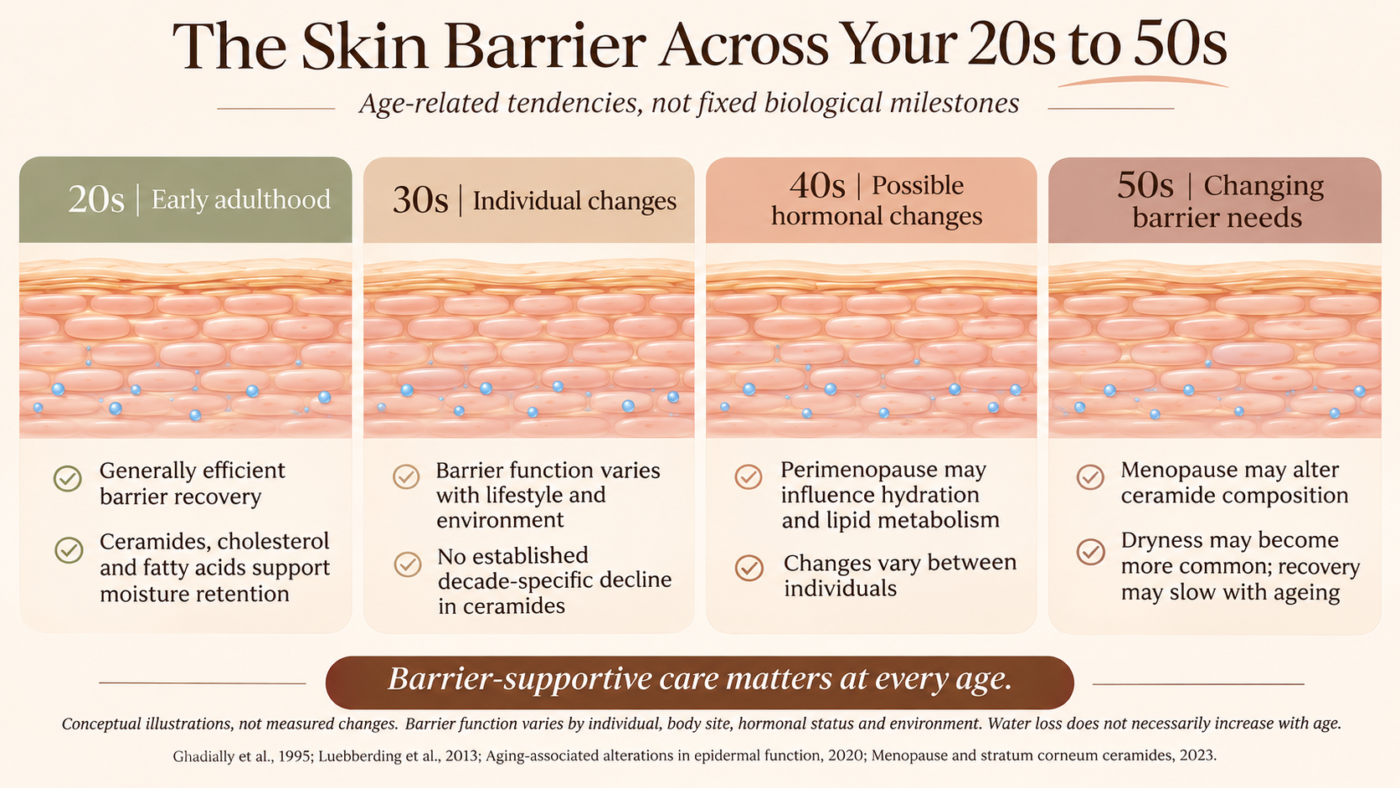
Think of your skin barrier — formally called the stratum corneum — as a beautifully engineered brick wall. The bricks are your skin cells (corneocytes), and the mortar holding them together is a lipid matrix made up of ceramides, fatty acids, and cholesterol. Together, they perform two equally vital functions: keeping moisture in, and keeping everything harmful out.
Disruption to this structure doesn’t just mean dryness. It means inflammation, sensitivity, accelerated ageing, and skin that simply cannot respond to even the most thoughtfully chosen products. A compromised barrier renders your serums, your moisturisers, your treatments — all of it — far less effective.
And after 50? Oestrogen decline accelerates the breakdown of the lipid mortar. Ceramide production falls significantly. Cellular turnover slows. The wall, as it were, develops cracks.
The good news: this is absolutely something you can address. And it begins by understanding your skin type — because the approach is not one-size-fits-all.
How to repair your barrier, by skin type
Below, I’ve outlined barrier repair strategies for five common skin presentations at 50+. Read your skin, not your old skin type — our skin changes considerably after menopause, and many women find they’re working with a different canvas than they were in their forties.
Dry Skin most common post-50
Signs your barrier is struggling
- Tight, papery feeling even after moisturising
- Fine lines more pronounced in the afternoon
- Flaking, especially around the nose and forehead
- Redness or a dull, ashy appearance
Your barrier-first routine
- Cleanse gently, once a day Dry skin after 50 rarely needs twice-daily cleansing. A milky, low-pH, fragrance-free cleanser in the evening is sufficient. Morning: rinse with lukewarm water only.
- Layer humectants before occlusives Apply a hyaluronic acid or glycerin serum to slightly damp skin, then seal immediately with a rich emollient — look for ceramide NP, shea butter, or squalane. Don’t let the humectant sit exposed; it will pull moisture from the skin instead of the air.
- Reach for a ceramide-rich moisturiser Ceramide 1, 3, and 6-II mirror your skin’s natural lipid matrix. Products formulated with a ceramide complex alongside cholesterol and fatty acids are clinically shown to restore barrier integrity. Use morning and evening without fail.
- Introduce actives slowly and always follow with barrier support If you use retinol or AHAs, sandwich them: apply your barrier moisturiser first, then the active, then seal again. This method dramatically reduces irritation in dry skin types.
- Use an overnight mask once or twice weekly A sleeping mask rich in beta-glucan, madecassoside, or ceramides gives the barrier extended repair time during your skin’s natural regeneration window.
Oily & Congested Skin Often over-stripped
Signs your barrier is struggling
- Shiny, yet somehow also tight or sensitive
- Breakouts alongside fine lines — confusing and frustrating
- Products “sting” or cause redness more than they used to
- Excess oil that worsens after you use strong actives
Your barrier-first routine
- Stop over-cleansing Over-cleansing — especially with foaming or alcohol-containing formulas — strips the lipid barrier, triggering more oil production. Switch to a gentle gel cleanser with a pH between 4.5 and 5.5, used twice daily maximum.
- Moisturise. Yes, really. Oily skin still needs barrier support. A lightweight, water-based gel moisturiser with niacinamide (which regulates sebum and calms inflammation) will hydrate without adding heaviness. Skipping moisturiser tells your skin to produce more oil.
- Swap harsh exfoliants for PHA or low-percentage BHA Polyhydroxy acids (PHAs) exfoliate gently while simultaneously reinforcing the barrier. If you prefer BHA, use salicylic acid at 1–2% no more than twice weekly, followed by a ceramide moisturiser to rebalance.
- Use niacinamide as your barrier ally Niacinamide at 4–10% supports ceramide synthesis, reduces transepidermal water loss, and visibly minimises pore appearance. It’s one of the most barrier-friendly actives for oily skin types at any age.
- Spot-treat rather than blanket-apply harsh ingredients Reserve benzoyl peroxide or high-concentration exfoliants to affected areas only, and always follow with targeted barrier repair around those zones.
Combination Skin Requires a zonal approach
Signs your barrier is struggling
- T-zone is oily; cheeks feel dry or flaky
- Uneven texture across different areas of the face
- Sensitivity in some zones, congestion in others
- Moisturisers that work on dry patches make oily zones worse
Your barrier-first routine
- Treat your face as two zones This is not overcomplicated — it’s precise. A ceramide-rich cream on cheeks and jaw; a gel moisturiser or niacinamide serum on the T-zone. Two products, thoughtfully placed, will outperform any “one formula for all” approach.
- Use a gentle, balanced cleanser everywhere A cream-gel or micellar cleanser works for both zones without stripping the dry areas or insufficiently cleansing the oily ones. Avoid foam cleansers with sulphates entirely.
- Apply your actives selectively Retinol or exfoliating acids belong on the T-zone, forehead, and chin — not across the cheeks unless those areas are also showing signs of congestion. Follow the same sandwich method as dry skin on any areas you’re treating.
- Use a barrier-repairing serum as your base layer A serum containing panthenol (pro-vitamin B5), madecassoside, or allantoin applied across the full face before your zone-specific moisturisers creates a unifying, calming base that speaks to both skin needs.
Sensitive & Reactive Skin Barrier is the priority, always
Signs your barrier is struggling
- Persistent redness, especially across the cheeks and nose
- Stinging or burning with products that didn’t cause this before
- Visible broken capillaries or a flushed appearance
- Skin that reacts to temperature, wind, or food triggers
Your barrier-first routine
- Audit and simplify your routine ruthlessly Sensitive skin at 50+ often reacts not to one ingredient but to the cumulative load of too many products. Strip back to three steps: cleanse, barrier moisturise, protect. Rebuild one product at a time, testing each for two weeks before introducing anything new.
- Prioritise anti-inflammatory actives Centella asiatica (CICA), madecassoside, bisabolol, and beta-glucan are your closest allies. These soothe inflammation while actively repairing the skin barrier — a dual action especially valuable for reactive skin.
- Choose fragrance-free, essential-oil-free formulations This is non-negotiable. Fragrance — including natural fragrance and essential oils — is one of the most common contact irritants. For barrier repair, there is no room for ingredients that exist only for scent. As a certified aromatherapist, I say this with full awareness: essential oils are powerful, and that power works against a damaged barrier.
- Consider a barrier-focused cleanser with micellar technology Micellar waters and gentle no-rinse formats minimise the mechanical stress of rinsing, which further disrupts reactive skin’s lipid matrix.
- Use cold or lukewarm water exclusively Hot water dissolves the lipid mortar directly. Every hot shower or facial steam removes ceramides and fatty acids. Make this one switch, and you’ll notice a difference within weeks.
Normal & Ageing Skin Maintain and prevent
Signs your barrier is shifting
- Skin that previously tolerated everything is now more reactive
- Lines that deepen quickly through the day
- Loss of plumpness and bounce, even when hydrated
- Recovery time after irritation is longer than before
Your barrier-first routine
- Introduce ceramides before you feel like you need them The best time to strengthen your barrier is before it begins to noticeably decline. A ceramide-rich moisturiser used consistently is preventive medicine for the skin. Think of it as structural maintenance.
- Layer strategically: toner → serum → moisturiser → oil (optional) A hydrating toner (with glycerin or hyaluronic acid) preps skin to absorb more from the serum. A peptide serum supports collagen architecture. A ceramide moisturiser seals. A facial oil on top — squalane, rosehip, or marula — provides an additional occlusive layer that slows transepidermal water loss overnight.
- Use retinol, but protect the barrier around it Normal skin tolerates actives well, but pairing retinol with barrier support ensures you’re building rather than depleting. Introduce retinol at 0.025–0.05%, 2–3 nights per week, and apply a ceramide cream before and after.
- Never skip SPF UV radiation is one of the most direct causes of barrier degradation and accelerated ageing. A broad-spectrum SPF 30–50 applied every morning — every morning, without exception — is the single most evidence-backed investment in your skin’s long-term health.
The ingredients doing the real work
Regardless of skin type, these are the barrier-supporting ingredients most validated by research for skin in its 50s and beyond. Look for them in your formulations:
Ceramides restore the lipid matrix and reduce water loss
Niacinamide stimulates ceramide synthesis, calms inflammation
Panthenol deep humectant with proven barrier-repair activity
Squalane biomimetic oil; absorbs cleanly without clogging
Centella Asiatica anti-inflammatory; accelerates barrier healing
Hyaluronic Acid multi-weight hydration across skin layers
Fatty Acids linoleic & oleic acids replenish intercellular lipids
Beta-Glucan soothes and supports immune response in the skin
Before you begin — barriers you may be building yourself
What to avoid when repairing your skin barrier
- Hot water on the face (strips lipids directly)
- Alcohol-based toners and astringents
- Fragrance in leave-on products, especially at night
- Over-exfoliating — more than 2–3 times per week with AHAs or BHAs
- Switching products too frequently (barrier recovery needs consistency)
- Skipping moisturiser on oily skin, thinking it will “help”
- Using multiple actives simultaneously without barrier support in between
How long does repair take?
This is the question I’m asked most often, and I want to answer it honestly. For mild disruption, consistent barrier support can show meaningful improvement within two to four weeks. For skin that has been significantly compromised — through years of harsh products, chronic over-exfoliation, or prolonged sensitivity — you may be looking at six to twelve weeks of dedicated, gentle care before the barrier stabilises.
Consistency, not intensity, is what the skin barrier responds to. It does not reward aggression. It rewards gentleness, patience, and the kind of steady, informed attention you are now beginning to give it.
In our next post, we’ll talk about introducing actives wisely — how to layer your treatments without undoing your barrier work, and which ingredients genuinely earn a place in a 50+ routine. Because skin repair and skin renewal can and should coexist.
“Your skin is not failing you. It is simply asking for a different kind of attention.”
